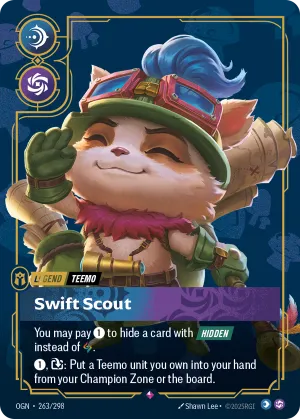
Can Teemo's Legend ability (Swift Scout) bounce a facedown card from the board to hand? | Runesight
Jul 15, 2026
Can Teemo's Legend ability (Swift Scout) bounce a facedown card from the board to hand?
Answered under Unleashed Rules FAQ and Clarifications
can return a facedown card from the board to your hand only if that facedown card is actually a unit you own and is a valid target when you put the ability on the chain. Because Hidden cards are placed facedown at battlefields (a Facedown Zone that is public), the facedown object is targetable — but you must be able to choose a valid unit as the target when finalizing the ability .
Final Ruling
Yes — 's ability can put a facedown card on the board into your hand, but only if that facedown card is a unit you own and is a valid target at the time you finalize the ability. Facedown Hidden cards at a battlefield reside in a Facedown Zone (a public zone) and therefore are eligible to be targeted by effects that refer to objects on the board . However, you must choose a valid unit you own when the ability is placed on the chain (valid choices must be made for all targets) . If you control the facedown card, you may look at its face and thus can confirm and choose it (per privacy rules) . If you do not control that facedown card and lack any other public information proving it is a unit you own, you cannot legally choose it as the target because you cannot make a valid choice as required to put the ability on the chain .
Citing
01
Activate 's ability and begin finalizing choices to put it on the chain.
02Identify the object you intend to return: the ability asks for "a unit you own" from your Champion Zone or the board, so you must choose a specific object that meets that criterion as you finalize the ability .
03If the candidate object is a facedown card hidden at a battlefield, it sits in a Facedown Zone (a public zone) and therefore is eligible to be chosen as a target by an effect that references board objects .
04You must actually be choosing a valid unit you own when placing the ability on the chain. If you control that facedown card, you may look at its face (privacy rules) and thus can confirm and choose it legally .
05If you do not control the facedown card and have no public information proving it is a unit you own, you cannot make a valid choice and therefore cannot legally target it when finalizing the ability .
06When the ability resolves, the chosen facedown unit you own is moved to your hand.
If the facedown object is not a unit (for example a facedown gear token placed by some effect), it is not a legal target because the ability requires a unit.
If multiple facedown cards are at the battlefield, you must choose one specific card that is a unit you own when finalizing the ability; you cannot choose a facedown card that you know cannot meet the requirement.
If information outside the board (previous reveals, game history, or effects that publicly identified the card) proves the facedown card is a unit you own, you may target it even if you don't currently control it, because you can make a valid choice at finalization .
Hidden cards are placed at battlefields you control. You cannot hide a card at a battlefield you don't control, so typically a facedown hidden card at a battlefield will be controlled by its hider; control determines who may look at its face .
Assumptions
Interpreting "from the Champion Zone or the board" as meaning the ability chooses a specific card as a target or choice when the ability is finalized (so normal targeting/choice rules apply) .
Hidden cards placed by Hide are facedown at a battlefield and therefore occupy a Facedown Zone (per 421.1) which is considered public for targeting purposes .
The key interactions are (1) where Hidden/facedown cards live, (2) what zones are public for targeting, and (3) the requirement to make valid choices/targets when putting an ability on the chain. Hiding places a card facedown at a battlefield you control, and facedown cards at battlefields have their permissions and properties defined by the hiding effect . Facedown cards at battlefields occupy a Facedown Zone, which is treated as a public zone for targeting purposes, so a board-referencing effect can target objects there . Privacy rules say only the controller of a facedown card at a battlefield may look at its face, so whether you can confirm that a given facedown object is a unit depends on who controls that facedown card .
When you activate 's ability, you must choose "a unit you own" from your Champion Zone or the board as you finalize the ability; valid choices for targets must be made at that moment . If the facedown card on the board is indeed a unit you own, it is a legal target and can be returned to your hand. If you control that facedown card you may look and confirm its identity and thus choose it. If you do not control it and you lack public information that it is a unit you own, you cannot legally choose it because you would not be making a valid target choice when the ability is placed on the chain .
Therefore, the practical rule: can bounce a facedown card from the board only when that facedown card is actually a unit you own (and you can make the valid choice when finalizing the ability). If you control the facedown, you can look and thus may choose it; if you don't control it, you need independent public information proving it meets the " unit you own" criterion before you can legally target it .