Can Zhonya's Hourglass be reacted at any moment to choose which unit to save, including le | Runesight
Jul 15, 2026
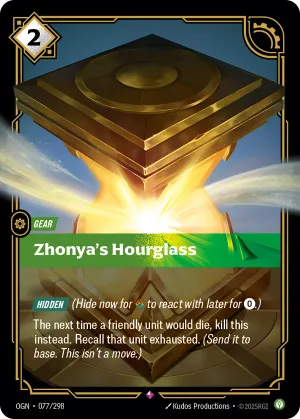
Can Zhonya's Hourglass be reacted at any moment to choose which unit to save, including letting one unit die first or choosing between multiple units dying simultaneously?
Answered under Unleashed Rules FAQ and Clarifications
Replacement effects like are not optional Reactions you can wait to play; they apply when the qualifying event (a unit "would die") occurs. If multiple deaths happen simultaneously, those death events are handled separately for replacement effects and the controller chooses the order in which to apply their replacement effects, so you can choose which simultaneous death to replace. You cannot let a death resolve and then retroactively apply the replacement to that already-resolved death.
Final Ruling
You cannot "react at any moment" to save a unit with after a death has already occurred. Replacement effects are applied when the event would occur and cannot be delayed past that point . However, if several units would die simultaneously, those death events are treated separately for Replacement Effects and you (the controller of the replacement) choose the order in which to apply Replacement Effects to those events, allowing you to pick which simultaneous death to save . If an event is already resolved (the unit is already dead), the replacement can no longer be applied to that event.
Citing
01When a unit "would die," the game looks for Replacement Effects that apply to that death event and those Replacement Effects must be considered at that time; you cannot defer applying them to after the death has occurred .
02If you control a Replacement Effect like , you either apply it to that death event (replacing the death with the alternate actions) or you do not; once the event resolves without the replacement, you cannot retroactively replace it .
03If multiple units would die simultaneously, the game treats each death event separately for Replacement Effects and you (the controller of those Replacement Effects) choose the order in which to apply Replacement Effects to those events; by choosing which death event to process first, you effectively choose which simultaneous death to save with your single replacement effect .
04If applying a Replacement Effect creates further events (for example, applying it causes its source to die), those newly created events are then eligible for Replacement Effects and are themselves processed per the replacement rules .
05If a Replacement Effect only becomes available by entering a specific zone (for example, a card in trash), it must be in that zone before the death event occurs in order to be eligible to replace it; otherwise it cannot be applied to that event .
If you control multiple Replacement Effects that could apply to the same simultaneous death events, you must order how those replacement applications are considered for those simultaneous events; your ordering choice can affect which units are ultimately saved . If different players' Replacement Effects would apply, applied Replacement Effects execute in turn order . If the object that would be saved changes zones such that it is no longer the same game object (e.g., it moves to a non-board zone) before replacement evaluation, the replacement cannot apply to that event per general replacement timing and zone rules .
Assumptions
The ruling assumes functions as a Replacement Effect that can replace "a friendly unit would die" with an alternate set of actions (as in the example given in the rules text), because the card text for is not provided in the supplied card data.
Replacement Effects are not "Reactions" you can choose to play at any time; they are effects the game evaluates and applies when the event they can replace is about to occur . That means you cannot allow a unit to die and then later decide to use to save it — the decision to apply the replacement must be made at the moment the death event is being processed, not afterward .
When multiple deaths happen simultaneously, the rules explicitly treat each death event separately for purposes of Replacement Effects and let the controller of those Replacement Effects pick the order in which to apply them . Practically, this means that if two (or more) of your units would die at the same time and you control a single , you can choose which of those simultaneous death events to process first and thus decide which unit the Hourglass replaces (i.e., which unit you "save") .
However, this choice only exists at the moment those simultaneous events are being processed. If the events are not simultaneous (one death fully resolves before another occurs), then when the first death event is processed you must either apply the replacement effect at that time or not; you cannot wait for later events to decide . Also, if a Replacement Effect must be present in a particular zone before the event to be eligible (for example, an effect that requires the card to be in your trash), it must be in that zone prior to the event occurring .
Finally, be aware that applying a Replacement Effect can create additional events (for instance, using the Hourglass might kill or banish the Hourglass itself), and those new events are then eligible for Replacement Effects and are processed according to the replacement rules . If multiple players' Replacement Effects apply, their applied Replacement Effects execute in turn order .