Answered under Unleashed Rules FAQ and Clarifications
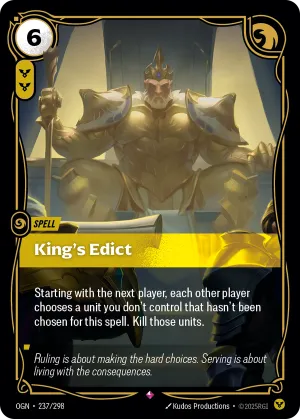
is a non‑targeting spell that, when it resolves, asks each other player in turn order (starting with the next player) to choose a unit you don't control that hasn't already been chosen for this spell, then performs a Kill action on all units chosen. Choices are made as the spell resolves; the Kill attempts happen immediately as part of that resolution. Deathknell triggers created by those kills are added to the chain as Pending Items before the units are moved to the Trash, so they can be responded to on the chain.
Final Ruling
When you resolve , do not choose targets during finalization. Instead, during the spell's resolution, starting with the next player and proceeding in turn order through the other players, each of those players chooses a unit you do not control that hasn't already been chosen for the spell (if they can). After those choices are made the spell's Kill instruction is applied to the chosen units. For any chosen unit with Deathknell, its Deathknell trigger is added to the chain as a Pending Item before that unit is moved to the Trash, per the Deathknell rules; if a chosen unit is no longer present when the Kill would be executed, that portion is ignored to the extent it can't be done. Cleanups cannot interrupt while the chain is resolving.
Citing
01
Play and place it on the chain; finalize it per the normal FEPR finalization process (choices/costs that belong to the spell's controller are handled during finalization) .
02When the spell reaches its Resolution Step, resolve its instruction: starting with the next player and proceeding through each other player in turn order, each such player chooses a unit you don't control that hasn't already been chosen for this spell. These choices are made as the spell resolves and are not 'targets' in the targeting sense .
03After the choices are collected, the spell performs the Kill instruction on each chosen unit. For any chosen unit that is no longer present on the board at that moment, that Kill can't be performed for that unit and is ignored to the extent it can't be done .
04For each chosen unit that would be killed and has Deathknell, add its Deathknell trigger to the chain as a Pending Item before moving the unit to its owner's Trash; then move the unit to the Trash .
05After finishes resolving, the chain will contain any Deathknell triggers added; those pending items must be finalized and resolved in order per normal chain procedure .
06No Cleanup will interrupt the resolution of the chain while these items are resolving; any Cleanup that becomes outstanding will be queued until after chain resolution completes .
If a player cannot choose any unit you don't control (for example they control no such units), they simply choose nothing; the instruction is followed as much as possible and that player's portion is ignored .
If a unit is chosen by an earlier player then later changes zone or is otherwise removed before the Kill is applied, the Kill for that unit is ignored/partially followed as applicable and Deathknell will not occur for it if it is not sent to the Trash by the Kill instruction (see and ).
If a replacement effect replaces the Kill with something else (for example, a recall), Deathknell will not trigger because the permanent was not sent to the Trash .
Because choices are made by other players as the spell resolves and the spell does not 'target' them in the sense described by the rules, effects that only prevent targeting do not stop from having a player choose their unit .
If a Deathknell trigger is added to the chain as a Pending Item, it will be finalized and can be responded to like any other chain item; Cleanups that would result from those resolves are queued until the chain finishes .
Assumptions
Standard turn order applies and 'next player' means the next player in turn order after the spell's controller.
There are no replacement effects or other continuous effects not provided in the context that would change how a Kill instruction or Deathknell works (e.g., replacement preventing a Kill or replacing it with a recall).
The card text shown is the complete relevant text of and there are no additional hidden instructions on the card.
Interpretation and sequence for : The card's instruction "Starting with the next player, each other player chooses a unit you don't control that hasn't been chosen for this spell. Kill those units." is an instruction that has players choose objects as part of the spell's resolution rather than a set of targets chosen during finalization. The rules explicitly cover spells that ask 'each player chooses a unit to kill' as non‑targeting and state those choices are made as the spell or ability resolves .
Practical sequence: you play and it becomes an item on the chain and is finalized per normal FEPR procedure . When the chain resolves the spell reaches its Resolution Step and executes its instruction. At that moment, beginning with the next player and proceeding through the other players in turn order, each of those players chooses a unit you don't control that hasn't already been chosen for this resolution (if they can). Because those are choices made by the other players during resolution, this is not a 'targeting' action in the sense described in the targeting rules .
After the choices are made, the spell's Kill instruction is applied to the chosen units. If a chosen unit is no longer on the board at the moment the Kill would act (for example it moved or was otherwise removed), that Kill can't be performed for that unit; instructions that can be partially followed are followed as much as possible and ignored otherwise , and if the spell checked properties of a unit that no longer exist those checks return null .
For any chosen unit that is killed and has Deathknell, the Deathknell trigger is added to the chain as a Pending Item before the unit is moved to the Trash as a result of the Kill instruction . That means those Deathknell triggers will be on the chain and available to be finalized and resolved (and responded to) after resolves. If a chosen unit's kill is replaced or it isn't sent to the Trash (for example a recall replaced the kill), its Deathknell will not occur .
Finally, remember that while chain items are resolving, Cleanups cannot occur; any Cleanup that would be created by events during resolution is made an Outstanding Task and will be handled after the chain finishes resolving . This ensures Deathknell triggers added during the Kill will be placed on the chain and handled before Cleanup processes that might otherwise run.
In short: choices are made during resolution (not as targets), kills happen immediately in that resolution, Deathknell triggers are added to the chain before those units are moved to Trash, and everything follows the usual rules for partially executable instructions and chain resolution .