Answered under Unleashed Rules FAQ and Clarifications
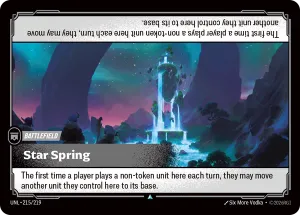
When you play a non-token unit onto the Battlefield , the Battlefield's passive ability can trigger the first time that player plays a non-token unit there that turn. If that trigger resolves, that player may move a different unit they control that is currently at that same battlefield to its base. The move is performed by the effect of (not the unit's Standard Move), and if the chosen unit is no longer a legal object at resolution the instruction is ignored.
Final Ruling
When a player plays a non-token unit onto and it is the first time that player has done so at that battlefield this turn, the ability may be placed on the chain. When that chain item resolves, its controller may choose another unit they control that is currently at that battlefield (not the unit that was just played) and move it to its base. The movement is a game effect and does not itself require the unit to be exhausted as a Standard Move would. If the chosen unit is no longer on the board or otherwise becomes an illegal object by resolution, the move instruction is ignored.
Citing
01Player A plays a non-token unit to the battlefield that has during a Main Phase (playing the unit follows the normal Play Card process; costs are paid and the card is finalized/placed on the chain) .
02When the unit enters the board at that battlefield, that fulfills the 'plays a non-token unit here' condition for and — because this is the first time that particular player has done so at that battlefield this turn (per the card text) — the ability becomes available to be placed on the chain as a triggered/pending item. The game will create any Outstanding Tasks associated with board changes (see Cleanups) .
03The triggered ability for is finalized/placed on the chain following the normal FEPR finalize/execute process; any decisions that belong to the triggered ability (for example, choosing whether to put it on the chain if the ability read that way) are made during finalization consistent with the triggered-ability sequencing rules .
04When the chain item resolves, its controller may choose another unit they control that is currently at that same battlefield (it must be a different unit than the one just played per the word 'another') and move that chosen unit to its base. That move is performed by 's effect; it is not the unit taking a Standard Move and therefore does not require exhausting as the cost for a Standard Move would .
05If the chosen unit becomes an illegal target or changes zone to or from a non-board zone before the effect resolves (for example, it dies, is recalled to a non-board zone, or otherwise ceases to be the same game object), the instruction to move it is ignored per the targeting/illegal-instruction rules .
If a player plays multiple non-token units 'simultaneously' (via some effect that puts multiple units onto the battlefield at once), the provided Core Rules context does not explicitly define how 'the first time a player plays' is evaluated for simultaneous plays. Absent more text, assume the controller chooses an order or the game treats them as a single event; this is an ambiguity and would require card-specific or broader rules not present here.
If the only other unit at that battlefield is the unit that was just played, it cannot be chosen because the text says 'another unit.' If no legal 'another' unit exists when the ability resolves, nothing happens.
If the chosen unit is moved to a different battlefield (but remains on the board) before resolution, it may or may not be a legal recipient of the effect depending on whether the ability required the unit to be 'here' at resolution. The text of specifies 'another unit they control here,' so if the chosen unit is no longer 'here' (the same battlefield) at resolution, the instruction cannot be followed and is ignored .
If a player's triggered ability is placed on the chain but then that player plays additional cards or opponents add responses, the item will resolve in order on the chain like any other pending item .
If a unit moved by would be moved to its base but that base is somehow an illegal destination (no rule in the provided context forbids moving a unit to its base), the instruction is not explicitly covered in the provided context; by default, moving to the unit's base is legal unless another effect restricts it.
Assumptions
The card text "the first time a player plays a non-token unit here each turn" is read as once per player per turn (i.e., each player gets that "first time" opportunity on their play), because the Core Rules context provided does not contain an explicit global vs. per-player interpretation of that phrasing.
The phrase "move another unit they control here to its base" is an effect produced by , not a Standard Move, so it does not require exhausting the moved unit. The Core Rules excerpt does not explicitly state that battlefield-instructions to "move" must use the Standard Move, so this ruling treats the card's instruction as a direct move effect.
The Core Rules context provided does not include the full Passive/Triggered ability rules text, so I rely on the general Finalize/Execute (FEPR) and targeting/legality rules given to explain when the choice is made and what happens if the target becomes illegal.
Text and intent of : "The first time a player plays a non-token unit here each turn, they may move another unit they control here to its base." Read literally, this creates a triggered effect tied to the event 'a player plays a non-token unit at this battlefield' and gates it by 'first time ... each turn.' The most defensible reading (given the phrasing 'a player') is that the restriction applies per player per turn: each player, the first time that they play a non-token unit at that battlefield in a given turn, gets the opportunity. When the play happens it follows the normal play-card FEPR process and the board change will make a Cleanup/Outstanding Task as appropriate . That Outstanding Task / triggered ability is placed on the chain and finalized like other triggered abilities; choices that form part of finalization (e.g., the specific unit to be moved) are made during finalization per the triggered-ability sequencing guidance . When the chain item resolves, its instruction is executed: the controller may move another unit they control that is at that battlefield to its base. Because the card's text is an effect that moves the unit, it is not the unit performing its Standard Move and therefore does not require exhaustion as the Standard Move cost would . If the chosen unit ceases to be a legal object (for example, it leaves the board, dies, or is otherwise no longer the same game object) before the effect resolves, the instruction to move it cannot be followed and is ignored . Notes about ambiguous points: the provided Core Rules excerpt does not define explicitly whether 'first time a player' is per-player or global, nor how to treat simultaneous placement of multiple units for the purposes of 'first time.' Those are listed as assumptions above and would require the fuller rules/FAQ or card errata to resolve absolutely.