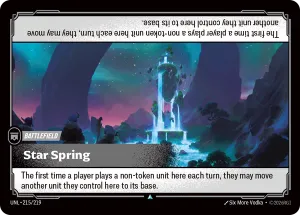
Answered under Unleashed Rules FAQ and Clarifications
is a Battlefield with a triggered ability that watches for the first time each turn that a player plays a non-token unit to that battlefield. When that condition is fulfilled, the player who played the unit may choose to put the triggered ability on the chain; if they do, they pick another unit they control at and, when the triggered ability resolves, that chosen unit is moved to its base.
Final Ruling
When a player plays a non-token unit to , after the play is processed the battlefield’s triggered ability’s condition is checked. The player who played the unit is the player referenced by “a player”/“they” and is the one who may choose to put the trigger on the chain and make the subsequent move choices (see ). If they choose to place the trigger on the chain, a pending chain item is created for the triggered ability and, during finalization, they choose which other unit they control at will be moved to its base . When that chain item resolves it performs the move. The ability only triggers for non-token units and only the first time that particular player plays a non-token unit at each turn.
Citing
01Player X plays a non-token unit to the battlefield ; playing a card creates a Chain item for that play .
02After the unit-play event is processed, the battlefield’s triggered-ability condition (“the first time a player plays a non-token unit here each turn”) is evaluated and, because the ability text includes a “may,” the player who played the unit chooses whether to put the triggered ability on the chain .
03Because the battlefield ability’s choices are made by the player who performed the action, that player is considered the controller of the triggered ability for this instance and is the one to add it to the chain and make any further choices required by it .
04If that player chooses to put the trigger on the chain, a Pending Item representing the triggered ability is added to the chain , creating a Closed State and causing the Finalize step to occur. During finalization, the player chooses which "another unit they control here" will be moved and selects the move destination (the unit’s base) as required for Move effects .
05When the triggered ability resolves as it comes off the chain, it performs the move and moves the chosen unit from to that unit’s base.
If the triggering play was a token unit, the ability does not trigger because the condition is explicitly for a non-token unit.
If there is no legal “another unit they control here” at the time the player would finalize the triggered ability (for example, the played unit is the only unit they control at ), the player should decline to put the trigger on the chain (the “may” allows this). If they nevertheless add a pending item and cannot make required finalization choices, the pending triggered ability cannot be finalized to a legal chain item under the limited context provided and will not produce a move (see assumptions).
If the chosen unit is moved or leaves the board after the trigger is finalized but before it resolves, whether the move can still occur depends on whether the targeted object is still a legal target on resolution. The provided excerpts do not contain the complete target-validation-on-resolution rules, so the practical handling of that situation follows standard target legality checks (if the object is no longer a legal target, the effect will be unable to affect it).
Assumptions
“The first time a player plays a non-token unit here each turn” is tracked per triggering player (i.e., each player gets their own “first time” for that turn). The provided rules do not explicitly state per-player tracking, but this is the most defensible interpretation of “a player” as the subject of the trigger and consistent with how “the [Nth] time” phrasing is applied to the actor who performed the action .
If the player chooses to place the triggered ability on the chain but, during the subsequent finalization step, there is no legal “another unit they control here” to choose (for example because no other friendly unit is present at ), the trigger cannot be finalized to produce a legal effect. Because the rules excerpt on finalization of triggered abilities is limited in the provided context, this is presented as a reasonable operational assumption consistent with the finalization/targeting rules .
The text of reads: "The first time a player plays a non-token unit here each turn, they may move another unit they control here to its base." This is a triggered ability using the “the [Nth] time” phrasing, so it is a triggered ability whose Condition is evaluated after the relevant event (a unit being played) is processed . When a player plays a non-token unit to , playing a card creates a Chain item for that play . After that play is processed, the condition on is evaluated and, if this is the first time that player has played a non-token unit at this turn, the trigger condition is fulfilled .
The card’s text places a “may” immediately after the trigger condition. Per the triggered-ability sequencing clarified in the rules and FAQs, that “may” is the player’s decision whether to put the triggered ability on the chain when the Condition is fulfilled . The FAQ for battlefield abilities further clarifies that when a battlefield ability indicates that a specific player makes a choice, that player is the controller of the ability for that instance—so the player who played the unit is the one who decides whether to add the trigger to the chain and who makes any choices for it .
If that player chooses to place the trigger on the chain, a Pending Item representing the triggered ability is added to the chain . Finalization then requires the controller to make any choices required by the ability; for a move effect that means choosing a valid unit to move and the move destination (the unit’s base) during finalization . The ability’s text requires moving “another unit they control here,” so the chosen unit must be another unit the same player controls that is present at (i.e., the unit must be at "here"). The move effect resolves when the chain item resolves and moves the chosen unit to its base.
Notes and practical points:
- The trigger only cares about non-token units; token plays do not satisfy the condition.
- The "another" qualifier prevents selecting the unit that was just played as the moved unit.
- This is not the Standard Move action described in rule ; the move performed by is an effect that moves a unit as part of an ability resolving (so the Closed/Open State and Standard Move timing restrictions do not apply to this effect in the same way as the inherent Standard Move action).
- If there are no legal choices for the “another unit” move, the player should not choose to add the triggered ability to the chain because the ability does nothing without a legal unit to move (see assumptions). The provided core excerpts do not fully resolve every corner case about finalization with missing targets, so that practical fallback is stated as an assumption consistent with the finalization/triggering guidance .
In short: play a non-token unit at → after the play is processed the player who played it may put ’s triggered ability on the chain → if they do, they pick a different unit they control at during finalization → when the triggered ability resolves it moves that chosen unit to its base.