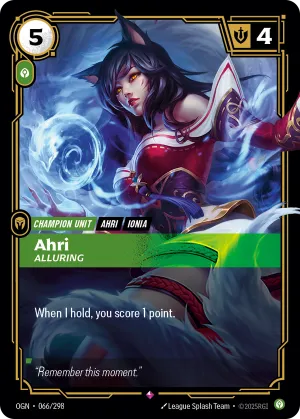
When an enemy unit attacks a battlefield you control, give it -1

this turn, to a minimum of 1
.
Legend · Rare
When an enemy unit attacks a battlefield you control, places a temporary -1 Might modifier on that attacking unit for the turn, but never reducing a unit below 1 Might. The most common misplay is thinking this can reduce a unit to 0 Might (killing it) or that it permanently changes base Might.
An enemy unit attacks your battlefield and 's trigger resolves before Combat Damage is assigned.
The unit's Might is reduced by 1 for that turn before damage is assigned; the reduced Might is used when summing Attacker Might and assigning combat damage .
Two enemy units attack your battlefield at the same time.
Each attacking unit that meets the trigger condition creates its own trigger. Each trigger resolves separately and only affects its own referenced attacking unit. Multiple separate reductions (from multiple triggers or multiple sources) will each apply, subject to the card's minimum-1 restriction and usual timing rules .
An attacking unit is already at 1 Might when the trigger resolves.
Because the card's text specifies a minimum of 1 Might, the effect will not reduce that unit below 1; effectively the resolution will do nothing to the unit's Might in this case .
Control of the attacking unit changes after the trigger goes on the chain but before the ability resolves.
Information such as “enemy” is referenced from the triggered ability itself and may be checked from that trigger when the ability executes. The trigger will still reference the unit identified when the trigger occurred; control changes after the trigger was created do not make the triggered instruction invalid merely because controller changed .
The attacking unit is moved off the board (to a non-board zone) before 's triggered ability resolves.
The provided Core Rules context does not fully specify how this triggered ability's relationship to the unit is handled if the unit moves to a non-board zone prior to resolution. There is a related clarification for spells that target game objects which keeps the relationship while objects remain on the board and severs it if the object moves to a non-board zone , but that FAQ is specific to targeted spells and does not definitively establish how a triggered ability worded as this one should behave in all cases. Therefore the rules context is insufficient to give a complete ruling for this exact situation.
Does permanently change a unit's base Might?
No. The card grants -1 Might “this turn,” which is a temporary change to the unit's current Might and expires at the end of the turn. Units are evaluated by their current Might while effects are active .
If 's reduction resolves before the Combat Damage Step, will that lower the damage the attacker deals?
Yes. Combat damage uses units' current Might during the Combat Damage Step; a reduction that is active when damage is assigned and dealt will reduce the amount of damage assigned by that attacker .
Can reduce a unit's Might to 0 or kill it immediately?
No. The effect explicitly states a minimum of 1 Might, so it cannot reduce a unit to 0 Might or kill it by reducing its Might. If a unit is already at 1 Might, the effect will not change its Might .
If the unit moves off the battlefield or to my opponent's control before the triggered ability resolves, will it still be affected?
The Core Rules excerpt provided explains that some information (like whether something is an enemy) is referenced from the trigger and may still be used when the ability resolves . However, whether the triggered ability maintains a relationship to the unit if it moves to a non-board zone prior to resolution is not definitively covered by the provided rules. There is a related clarification about targeted spells staying linked to targets while they remain on the board and being severed if they move to a non-board zone , but that FAQ does not fully settle all triggered-ability cases. Therefore the provided context is insufficient to give a complete answer for all possible move scenarios.
Do multiple instances of this effect stack?
Each instance of the effect that resolves will apply a -1 Might modifier for the turn; multiple instances therefore stack in the sense that they each change current Might as they resolve, subject to the card's minimum of 1 Might. The unit's resulting current Might after all applicable effects resolve is what is used for further evaluations .